Built as a modular web app with typed data contracts, module-level views, and repeatable operating workflows.
Real Estate Intelligence Dashboard
Decision intelligence for real estate operators.
URDNAI has built a real estate intelligence dashboard that helps operators read Australian markets, agencies, agents, buyers, suburbs, source confidence, and recommended next actions from one evidence-led decision surface.
Discuss the dashboardBuilt System
A working intelligence layer for real estate decisions.
Designed for Australian suburb, postcode, region, franchise territory, rent-roll, and custom catchment views.
Source freshness, confidence, caveats, evidence trails, and human-review states stay visible beside the recommendation.
Screen Grab
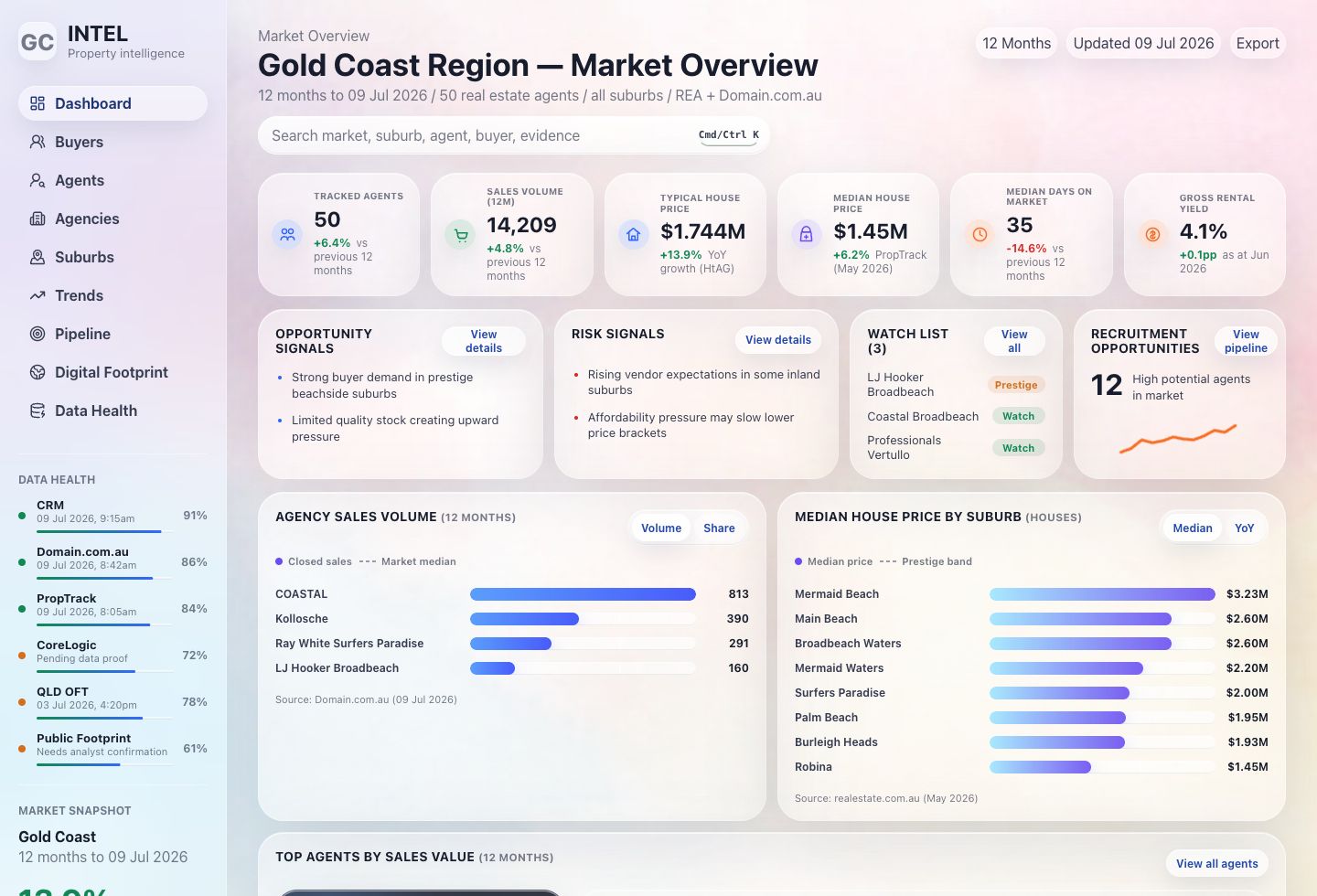
The main dashboard is built as an operator command surface.
The first screen brings market metrics, agency targets, evidence inspection, buyer intelligence, source health, and action prompts into one view so leaders can move from signal to decision.
Data Connectors
Built to connect with the systems real estate operators already use.
CRM and agency systems
Agentbox
VaultRE
Rex
LockedOn
Box+Dice
Eagle Software
PropertyMe
PropertyTree
Console Cloud
Portals and listing surfaces
realestate.com.au
Domain
Rent.com.au
Homely
Allhomes
RateMyAgent
OpenAgent
LocalAgentFinder
Market, comms, and workflow data
Pricefinder
Cotality
RP Data
REI Forms Live
Office 365
Google Workspace
Meta Ads
Google Ads
Mailchimp
Connector availability depends on API access, export permissions, licensing, data-processing terms, and the governance controls required for each agency.
Modules
The dashboard is shaped around the decisions real estate leaders actually make.
Buyer Intelligence
Buyer conversion should not be flattened into one opaque score.
-
01
RFM engagement
Recency, frequency, and demonstrated commitment show whether a buyer is actually engaging, not just sitting in the CRM.
-
02
Property-specific intent
Inspections, repeat engagement, reports, offers, and other high-cost actions are separated from weaker generic activity.
-
03
Language and sentiment
Messages and notes can reveal constraints, urgency, objections, emotion, and path-to-yes signals when interpreted carefully.
-
04
Pattern similarity
Historical converter resemblance can be useful, but it should stay in shadow or calibration mode until enough labelled outcomes exist.
Growth Intelligence
Acquisition and recruitment decisions need market context beside every recommendation.
Acquire the whole agency, buy the rent roll, or recruit producers. Each play needs different evidence, timing, and risk controls.
Distress, motivation, momentum, and marketing investment help separate opportunities, threats, emerging players, and agencies to study.
Value, moveability, fit, risk, suburb focus, buyer overlap, licence movement, and relationship path inform recruitment timing.
Every target needs a source trail, confidence level, freshness state, caveat, and recommended next action before operators act.
Digital Footprint
Public professional signals can be useful when the method and limits stay visible.
Search, paid advertising, website, content, reviews, social, listings, corporate and hiring, and people/professional signals.
Market presence, brand momentum, marketing investment, reputation, distress signals, agent portability, and competitive movement.
No breach lookups, account enumeration, private social graph inference, port scanning, private personal data, or prohibited scraping.
Data Health
The dashboard shows which recommendations can be trusted today.
Fresh source data with usable confidence.
Still informative, but needs refresh before high-risk action.
Useful directionally while evidence or model fit is being proven.
Model or pattern signal visible for learning, not active decisioning.
Operator confirmation required before the signal drives action.
Sources disagree and the system should surface the disagreement, not hide it.
Questions
Real estate intelligence dashboard questions, answered plainly.
What is a real estate intelligence dashboard?
It is a decision surface that combines market, agency, agent, buyer, suburb, source-confidence, and evidence signals so operators can see what is happening, why it matters, and what action should happen next.
How can AI help with buyer intelligence?
AI can help separate engagement, property intent, language signals, sentiment, trajectories, data quality, and next-best outreach instead of relying on a single opaque conversion score.
How can data support agent recruitment?
Recruitment reads can combine value, moveability, fit, risk, suburb focus, buyer overlap, professional footprint, source confidence, and relationship path.
Can the dashboard connect to our existing systems?
Yes. The dashboard can be connected to CRMs, portals, licensed feeds, inboxes, calendars, marketing systems, call data, forms, websites, and internal databases where access rights and governance controls are in place.
Real Estate Intelligence